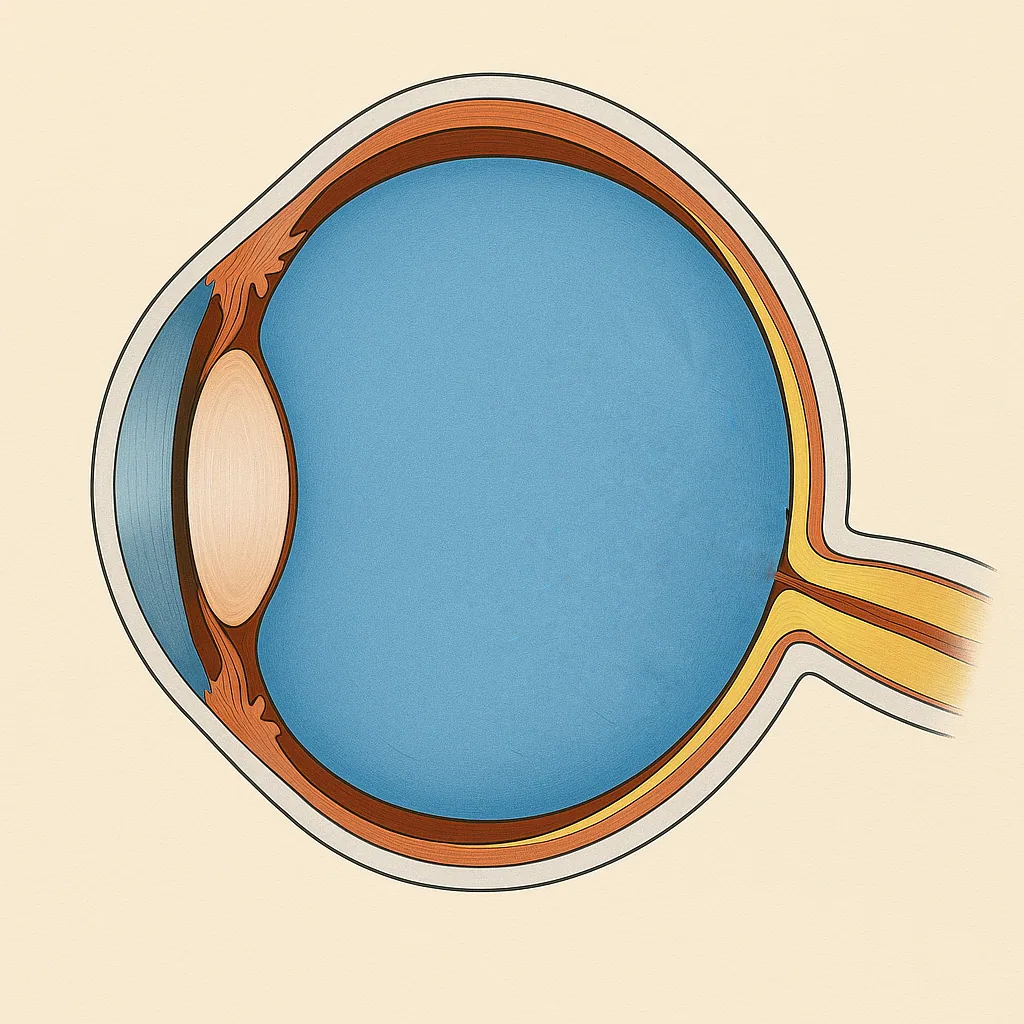

A dark curtain, dark veil or shadow invading your visual field is one of the most serious ophthalmological signs. It is an absolute emergency requiring immediate consultation — do not wait until the next day, do not hope the symptom will resolve on its own.
What is a dark curtain in the eye?
The dark curtain is a persistent area of darkness that invades your visual field, as if a veil or curtain were falling from one side or from the bottom of the eye. It may progress slowly or very rapidly, sometimes extending towards the centre of vision (the macula).
This symptom differs from simple visual fatigue or transient blur: it is stable or progressive, and is often accompanied by a sudden onset of floaters or flashes of light.
What causes a dark curtain in the eye?
The dark curtain is the hallmark symptom of retinal detachment: the retina progressively peels away from the eye wall, and the detached zone no longer transmits visual information. The shadow corresponds to the area of the retina that is no longer functional.
It can also be caused by a large vitreous haemorrhage, a complete retinal artery or vein occlusion, or more rarely by a choroidal or orbital process.
Why act within the hour?
The prognosis of retinal detachment depends directly on the speed of intervention. As long as the macula (the zone responsible for central, detail and colour vision) remains attached, the surgical outcome is excellent and visual recovery is near-complete in most cases.
Once the macula detaches — which can happen within hours — central vision is permanently compromised even after successful surgery. Every hour counts.
What to do if you see a dark curtain?
Contact an ophthalmologist immediately or go to an emergency ophthalmology department. Do not wait to see if the symptom resolves — retinal detachment does not improve spontaneously. If you notice this symptom outside of office hours, Dr Julien Gozlan is accessible via chat to assess your situation and guide you towards the appropriate emergency management.
Treatment of retinal detachment
Surgery is the only effective treatment for rhegmatogenous retinal detachment. Two main techniques are used: vitrectomy (removal of the vitreous with internal repair) and scleral buckling (external compression). The choice depends on the type and extent of the detachment, and on the patient's profile.
Laser photocoagulation and pneumatic retinopexy can be used in selected cases of limited peripheral detachment.
Further reading
Read the complete article by Dr Julien Gozlan : Retinal detachment — surgery and outcomes
Do you see a dark curtain in your vision?
Dr Julien Gozlan will respond within minutes.